The likelihood of an intact and complete delivery begins with proper labeling, packaging, and an accurate piece count and proper completion of the bill of lading. The following references and tips are provided to assist the shipper in ensuring their shipment is properly packaged to withstand the normal rigors of transportation and properly labeled to ensure the shipment arrives at the proper destination with all pieces properly accounted for.
Clark Freightways requires that each piece in your shipment be labeled with the
name, and complete address of the shipper and consignee. Proper labeling is required to ensure the shipment arrives on-time with all pieces accounted for. The shipper is responsible for ensuring the names and addresses contained in the freight labels matches the names and addresses of the bill of lading. Failure to properly and accurately label your shipment may result in loss or delay of your shipment without liability.
The shipper is responsible for ensuring the piece count is accurate and matches
the bill of lading.
The piece count is the total number of loose pieces shipped. For example five (5)
loose cartons is five (5) cartons. Five (5) cartons shrink-wrapped to a pallet is
one (1) skid containing five (5) pieces. Our drivers will sign for your shipment
in the following manner;
 SWS Containing 5 Pcs
In another example if your shipment consisted of two-hundred and twenty (220) cartons on seven (7) skids and the cartons are not verifiable by our driver, he will sign for the shipment in the following manner;
 SWS STC 220 Pcs
The SWS notation stands for “shrink-wrapped-skids” and the STC notations
stands for “said-to-contain”.
Clark drivers are trained to sign with a STC notation when they are unable to easily verify the piece count because of the configuration of the handling unit(s). Once a driver signs with a STC notation, Clark Freightways commits to transport and delivery your freight intact at destination without tampering to your shrink wrap. If the shrink is broken down during the transportation process, Clark Freightways takes responsibility for the number of pieces noted on the bill of lading.
Proper packaging is a must. Don’t ship your goods without proper protection.
Shippers are responsible for ensuring their freight is properly and adequately packaged to withstand the normal rigors of transportation. Numerous damage claims arise due to inadequate packaging which limit or even eliminate the carrier’s liability.
Shipping machinery or large irregularly shaped products will almost always require some kind of crating. The extent of crating required
will most often depend on the value and configuration of the shipment. It is recommend that good quality lumber be utilized and that three-way locking corners or diagonals be used to provide structural integrity to the crate. You must ensure the product is adequately packaged prior to pickup. If the driver does not believe the product is secure enough to withstand normal transportation and handling, the carrier may refuse to pick-up the shipment or insist the shipment moves at the Owners Risk of Damage (ORD).
Pallet Packaging Tips:
- Always use pallets that are in good condition. Damaged or worn pallets may result in damage to your freight during handling or shipping.
- Do not overload a pallet with weight, height or volume as it may result in the failure of the pallet and damage to your product.
- Adding a layer of cardboard dunnage on to the pallet prior to stacking greatly increases the protection of the bottom row of cartons from crushing.
- When shrink-wrapping your pallet after stacking, always start the shrink-wrap from the bottom of the skid for increased strength and always ensure the pallet is also included in the wrap.
When loading pallets for shipping, refer to the examples below:
Most Recommended
 Maximum structural strength of the boxes is maintained by vertically aligning the
cartons on the skid.- There should be no overhang of cartons over the edge of the pallet.
- Inserting a layer of cardboard over the empty pallet is an excellent way of protecting
the bottom row of cartons from crushing. - The top of the skid should be flat. Ideally a piece of cardboard would be placed
over the top layer of cartons. - The cartons should be secured to the pallet with shrink-wrap, from the bottom, up
for maximum strength.
Avoid Pallet Overhang
 Avoid stacking cartons with an overhang on the pallet.
- A half inch (1/2in) overhand results in a 30% loss in the strength of a carton.
- The bottom cartons will often fail simply as a result of the compression from the stacked pallet.
- The loss in strength is even more significant for pallets stacked with products in bags or other shipping modes.
Avoid Interlocking Cartons:
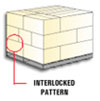 A common misconception is that interlocking cartons on a skid provides the most secure loading method.
- In actual fact, stacking in an interlocking pattern result in a loss of strength
to the load of 50%. - Using a vertical stack pattern results in a slightly less stable configuration but considerably more compression strength. Proper use of shrink-wrap will secure a vertically stacked skid.
Misaligned Cartons:
 Using a vertical stack pattern, but misaligning the cartons results in a loss of
compression strength of 30%.- In addition, the pallet once shrink-wrapped will have significantly less stability during transportation.
Double Stacking Pallets:
- When pallets are double stacked incorrectly there is significant compression placed on the bottom skid.
- In order to ensure the weight of the top skid is uniformly distributed, a layer
of cardboard dunnage or plywood should be used on the top of the bottom skid. - This ensures uniform the uniform distribution of weight over the entire top row of cartons on the bottom skid.
- Without a layer of dunnage, the top row of cartons on the bottom skid will almost certainly display signs of crushing.
Clark Freightways maintains reefer temperatures for all cooler products at a standard operating temperature well above 32 degrees Fahrenheit. However, depending on the placement within the trailer some fragile products such as live plants, peaches, etc, may be susceptible to air-chill through the standard operation of the reefer.
For this reason it is incumbent on the shipper of these types of products to ensure their shipping containers have adequate protection for their products from risks of air-chill. Plants and produce should never be shipped without the tops of the shipping container being enclosed and insulated with a layer of cardboard.




Testimonials
Anipet Animal Supplies
It is great to see that Clark Freightways is continuing to grow with their customers, is finding new ways to make our businesses connect better and is helping us to improve our efficiency and customer service.
Colonial Farms Ltd.
Colonial Farms Ltd. has been conducting business with Clark Freightways for more than 25 years. We have found them to be very reliable in the movement and delivery of our fresh product throughout B.C. The product arrives on time and in good condition. The office personnel and drivers are always helpful, courteous and responsive to our needs. We look forward to many more years of doing business together.
Elco Fine Foods Inc
Elco Fine Foods Inc. has been using Clark Freightways for several years. Our company has been very pleased with the service and professionalism of the Clark team from delivery to customer service.
Euro-Rite Cabinets Ltd.
As soon as we began doing business with Clark Freightways, they impressed me with their service, efficiency and professionalism. Our experience working with Clark confirms that we have partnered with true leaders in the freight business
Health Shared Services BC
HSSBC’s business relationship with Clark Freightways was founded on the Health Authorities requirement to procure 3rd party transportation solutions in support of the centralized services established in 2007 in Kelowna, BC.
What stands out for me is the exceptional responsiveness Clark Freightways applies to our queries; and the communication protocols established to support the vast geographical area we service.
Horizon Distributors
Clark has been providing us with excellent logistics solutions for nearly 20 years now. The Clark team fulfills every promise they make, and this is vital because they’re not only a delivery company but also an ambassador of Horizon: Their consistent performance makes us look good.
UNFI Canada
It’s rare to find someone who can deliver dry, fresh and frozen anywhere in the province without any issues, and it’s crucial to our retailers because they need the freedom to purchase from these three categories in order to make the hauling cost-effective.